
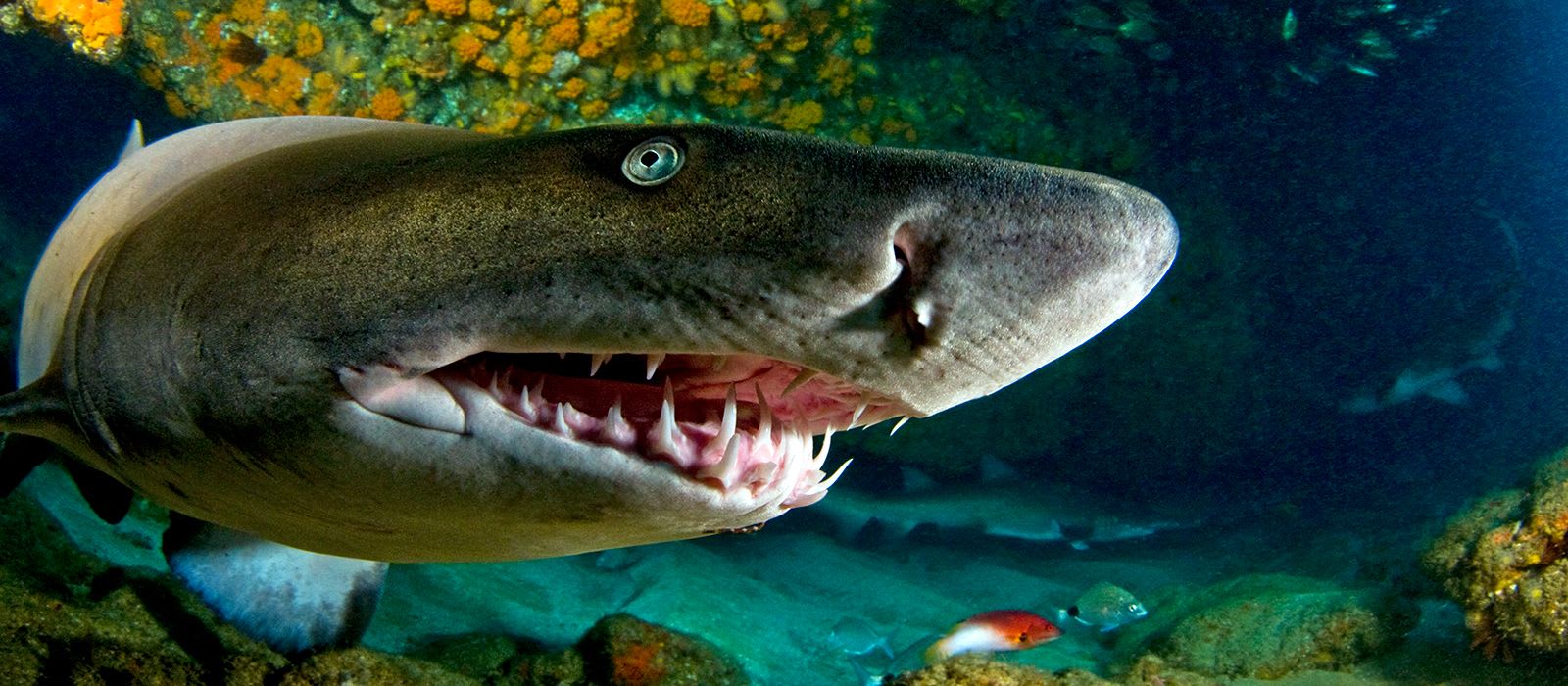
CREATURE FEATURE: Sandtiger Shark
This month we're showcasing the Sandtiger Shark.
Also known as the Raggedtooth and Grey Nurse Shark.
Despite their appearance, this shark is docile in nature.
They belong to the family Odontaspididae, which comes from the Greek words odous (teeth) and aspis (shield). But recent molecular analysis suggests they’re far more closely related (at least genetically) to Basking Sharks than members of their own family.
These large and heavy sharks are slow, but strong, swimmers. They can be seen alone or in groups of 20-80 individuals. Aggregations have been seen working together to herd fish and males display complex courtship behaviour.
Multiple paternity can occur in Sandtiger Sharks. So, after mating, males will guard the females from other males to improve the chances of their offspring surviving.
Sandtigers have a very low reproductive rate, giving birth to 2 pups every other year. Only the largest pups (from the first fertilised eggs) survive. After hatching inside the mother’s uterus they’ll proceed to eat all the other eggs, and even their smaller brothers and sisters too! Until just one pup survives in each uterus. This is known as adelphophagy or uterine cannibalism.
Sandtigers can hover motionlessly in mid water by gulping water at the surface, trapping air in their stomachs. This also causes them to let bubbles out of their mouth…or the other end!
Males mature at 6-7 years and females at 9-10 years. In the wild they live around 15-17 years. But in captivity they can live up to 30 years.
- SCIENTIFIC NAME: Carcharias taurus
- FAMILY: Odontaspididae
- MAXIMUM SIZE: ~3.2m
- DIET: Fish (including smaller sharks & rays), squids, crabs and lobsters.
- DISTRIBUTION: Warm-temperate and tropical Atlantic, Mediterranean and Indo-west Pacific.
- HABITAT: Coastal waters from the surf zone down to depths of 25m. Often found near rocky caves and coral reefs near the seabed.
- CONSERVATION STATUS: Vulnerable
Love Discovering Sharks?
Click the button below to discover more fascinating sharks and rays, covered in our Creature Features. Or why not delve deeper into the world of sharks by visiting our Discover Sharks section?
More Creature Features
Banner image © Dray van Beeck
Comments (1)
Anonymised User
They are the only animal in the entire animal kingdom that have adelphophagy (or intra-uterine cannibalism)! In addition, they are the only shark that can attain neutral buoyancy due to swallowing air. When they are resting, they swim slowly they actively pump water over their gills by briefly closing their mouth (active respiration). When they are more active, they swim fast with their mouths open and water flows over their gills by ram ventilation.